
Our history50 years in the making.
Shared medical notes can improve care processes and outcomes. Healthcare advocates have argued this for decades. Meanwhile, government policies help define how much access and control patients have over their medical records. Over the last 15 years, OpenNotes (now Open Notes Labs) has been researching what happens when these policies are put into practice.
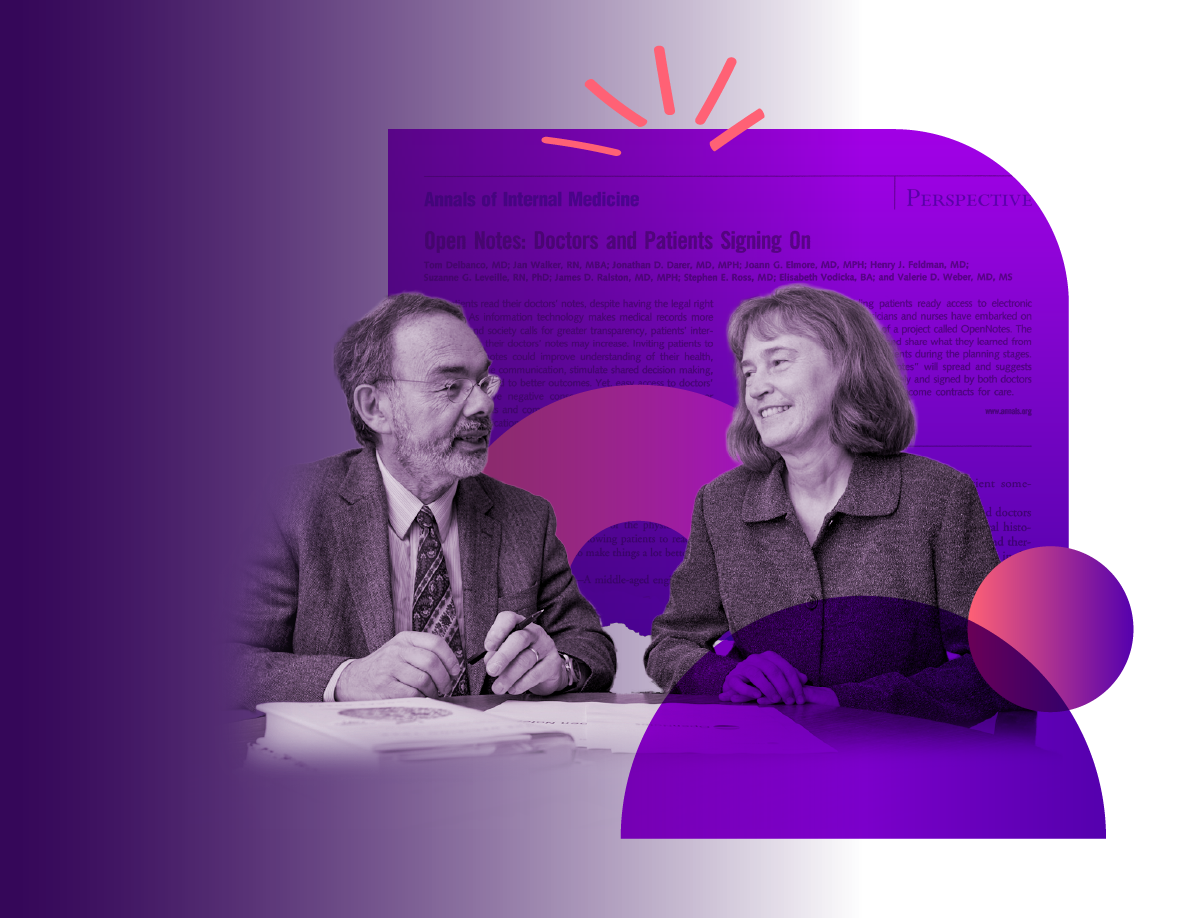
Tom Delbanco, MD, and Jan Walker, RN, MBA
1973
Offering every patient access. A New England Journal of Medicine article entitled “Giving Every Patient His Medical Record: A Proposal to Improve the System,” argues that “Four serious problems (maintaining high quality of care, establishing mutually satisfactory physician/patient relations, ensuring continuity and avoiding excessive bureaucracy) could be alleviated, in part, if patients were given copies of their medical records.”
1973
A new era of transparency. The American Hospital Association adopts A Patient’s Bill of Rights, emphasizing that “activities must be conducted with an overriding concern for the values and integrity of patients.” The Bill fuels the patient rights movement, outlining not only rights but also steps patients can take to become more active in their own care.
“Patients are responsible for informing their physicians and other caregivers if they anticipate problems in following prescribed treatment.”
— A Patient’s Bill of Rights
1991
Rise of the electronic health record. The National Academies of Medicine (formerly the Institute of Medicine) releases a report, “The Computer-Based Patient Record: An Essential Technology for Health Care.” It makes a strong case for electronic health records, saying they are essential to improving health care quality and safety.
“Recent experience has shown that access to data and information at the point of care and the ability to analyze data for management and research purposes improves the quality and reduces the costs of care.”
— The Computer-Based Patient Record: An Essential Technology for Care
1996
HIPAA changes the game. The Health Insurance Portability and Accountability Act was enacted by Congress and signed into law by President Clinton. An important component of HIPAA mandated that patients nationwide have the right to inspect, review, and receive copies of their medical records. This eliminates a critical barrier to access and eases the path toward open notes.
1998
Patient portals provide online access to health information. Health systems and technology companies begin to develop and adopt secure online websites, called patient portals. They allow patients to access parts of the personal health information in their medical record. Using these portals, patients can read information such as medication lists and limited test results, and many can send secure email to their health care team. But the notes clinicians write after a visit remain hidden from the patient’s view.

2009
Electronic health records (EHRs) become a national goal. The American Recovery and Reinvestment Act (ARRA) and the Health Information Technology for Economic and Clinical Health Act (HITECH) are introduced. HITECH included the concept of “electronic health records – meaningful use” (EHR-MU), which required health systems to offer patient portals and interoperable electronic health records throughout the United States.
2010
The OpenNotes study begins. Together, Beth Israel Deaconess Medical Center (Boston, MA), Geisinger Health System (rural PA), and Harborview Medical Center (Seattle, WA) launch an exploratory study. In the study, 105 primary care doctors invite 20,000 of their patients to read their notes via secure online portals. Funded by the Robert Wood Johnson Foundation, the study examined the effects of sharing notes on both patients and doctors.

2012
Publication of findings from the first OpenNotes study. Results from the 2010 study are published in the Annals of Internal Medicine. The big takeaways: doctors report little change in workload, and patients overwhelmingly approve of note sharing as a practice. Few are worried or confused by their notes. Instead, they report that reading notes helps them feel more in control of their health and health care. In response, several health systems make plans to adopt open notes.
2013
The VA shares notes systemwide. The U.S. Department of Veterans Affairs introduces an enhanced version of its “Blue Button” personal health record. The addition of open notes is a major part of the upgrade. More than a million veterans receiving care through the VA and authenticated on its health portal are now able to review and share the notes written by their health care team.
2013
Patient safety and two-way communication. The OpenNotes Patient Safety Initiative is launched with funding from CRICO/Risk Management Foundation of Harvard Medical School affiliates. The work investigates the potential effects of note-sharing on patient safety. OpenNotes researchers pilot an online reporting tool that invites patients to identify errors and inaccuracies and provide other feedback about their notes. Results showed that, when invited, one-quarter of patients and families identified potential medical documentation errors, half of which were considered “important” by the patients, families, and clinicians.
2014
Expansion into mental health. Beth Israel Deaconess Medical Center launches a pilot to invite patients to view notes written by their psychotherapists. Continued research and implementation at numerous sites across the U.S., including the VA, and Canada show that reading online mental health notes indicates patient experiences are more positive than negative. Survey respondents agree that having open therapy notes is a good idea, and many recommend that it continue. Advocates believe that note sharing can serve as an important tool in mental health care and reduce the stigma associated with mental illness.
2014
OpenNotes Consortia, Networks, and Learning Collaboratives. The OpenNotes Pacific Northwest Consortium is formed to support adoption and drive implementation of open notes across Oregon and Washington. As the first regional group to collaborate, they demonstrate striking leadership by working together on behalf of patients. Following success in the Pacific Northwest, OpenNotes consortia are formed across California, New York, and Wisconsin. Later, OpenNotes consortia form around topics of specific interest, including mental health, oncology, patient/family involvement, pediatrics/adolescents, quality clinical documentation, care partner access to the patient portal (“shared access”), and open test results. Open Notes Labs uses this model today for cross-site learning and dissemination.
2015
Looking to the future with OurNotes. The OpenNotes team receives support from the Commonwealth Fund and the Drane Family Fund to develop OurNotes, an initiative that promotes active patient engagement in health and illness by inviting patients to contribute to their own electronic health records. Five million people now have access to open notes.
2015
Moore, Peterson, and Cambia join RWJF. The Gordon and Betty Moore Foundation, Peterson Center on Healthcare, and Cambia Health Foundation join the Robert Wood Johnson Foundation and announce generous new funding to support innovation, research, and the goal of spreading open notes to 50 million patients nationwide by 2020.
2016
Open notes reach 10 million patients. Catherine (Cait) M. DesRoches, DrPH, joins OpenNotes as its first Director and announces that 10 million Americans can now choose to read their medical notes securely online.

2020
Open notes continue to spread. More than 50 million patients in the U.S. and Canada have gained access to their notes. Adoption of this fundamental change in practice accelerates rapidly.
2021
Federal law mandates open notes. Beginning April 5, 2021, all U.S. healthcare systems are required to electronically share clinicians’ visit notes with patients at no charge. The program rule on Interoperability, Information Blocking, and the Office of the National Coordinator for Health IT Certification—which implements the 21st Century Cures Act passed by a bipartisan Congress in 2016—now requires U.S. patients to be provided access to all the health information in their electronic medical records without charge by their healthcare provider. As a result, this made the concept of open notes the “law of the land.”
2022
Large language models transform healthcare. AI is introduced to the general public and changes every professional sector. Large language models (LLMs) offer patients the opportunity to query their medical information between doctors’ visits and better understand their medical records. However, there are risks of responses that are inappropriate, inconsistent, or incorrect.
In response, OpenNotes launches OpenNotes Lab as an environment to test new initiatives in partnership with clinicians, patients, and developers.
Present
OpenNotes formally rebrands as Open Notes Labs. The rebrand represents the evolution of our mission while maintaining our commitment to the future of transparent healthcare.
The name “Open Notes Labs” reflects what we have become: more than a research initiative, but rather comprehensive labs that study, spread, and teach transparent communication across diverse audiences. Open Notes Labs continues to partner with health systems, clinicians, researchers, technology partners, patients, and care partners.